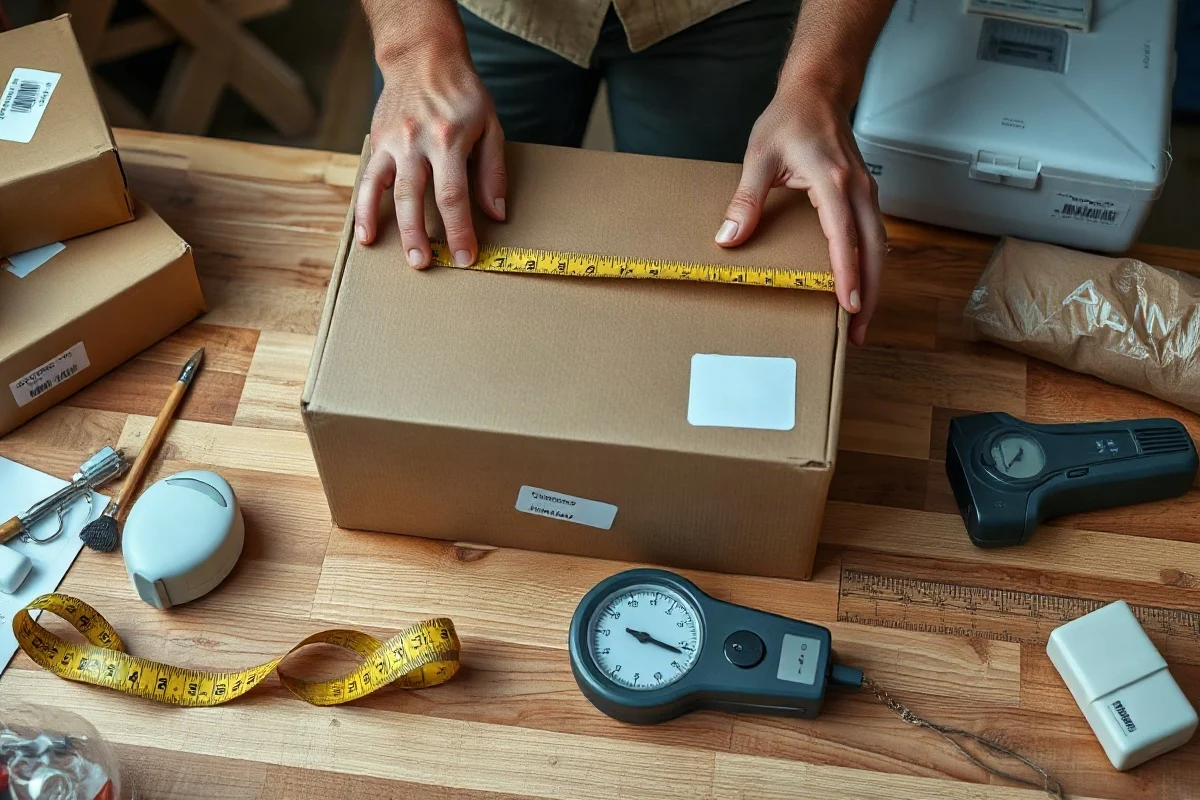
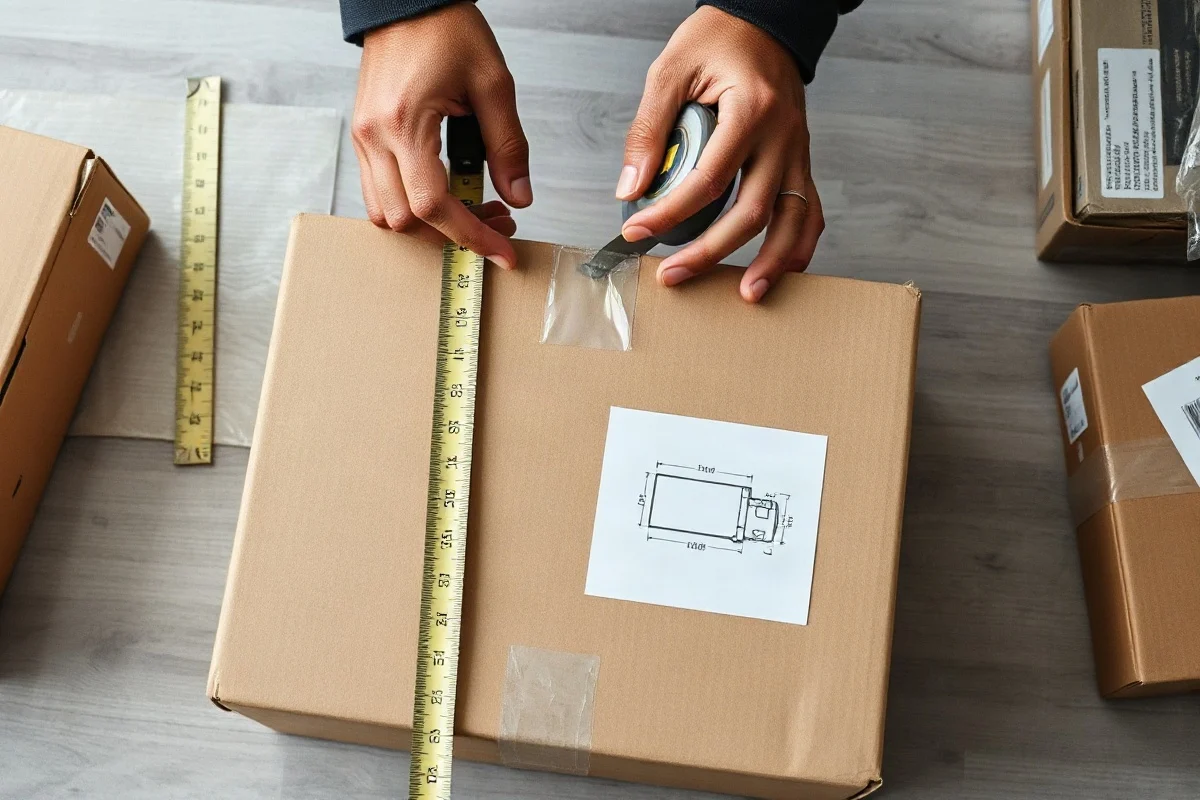
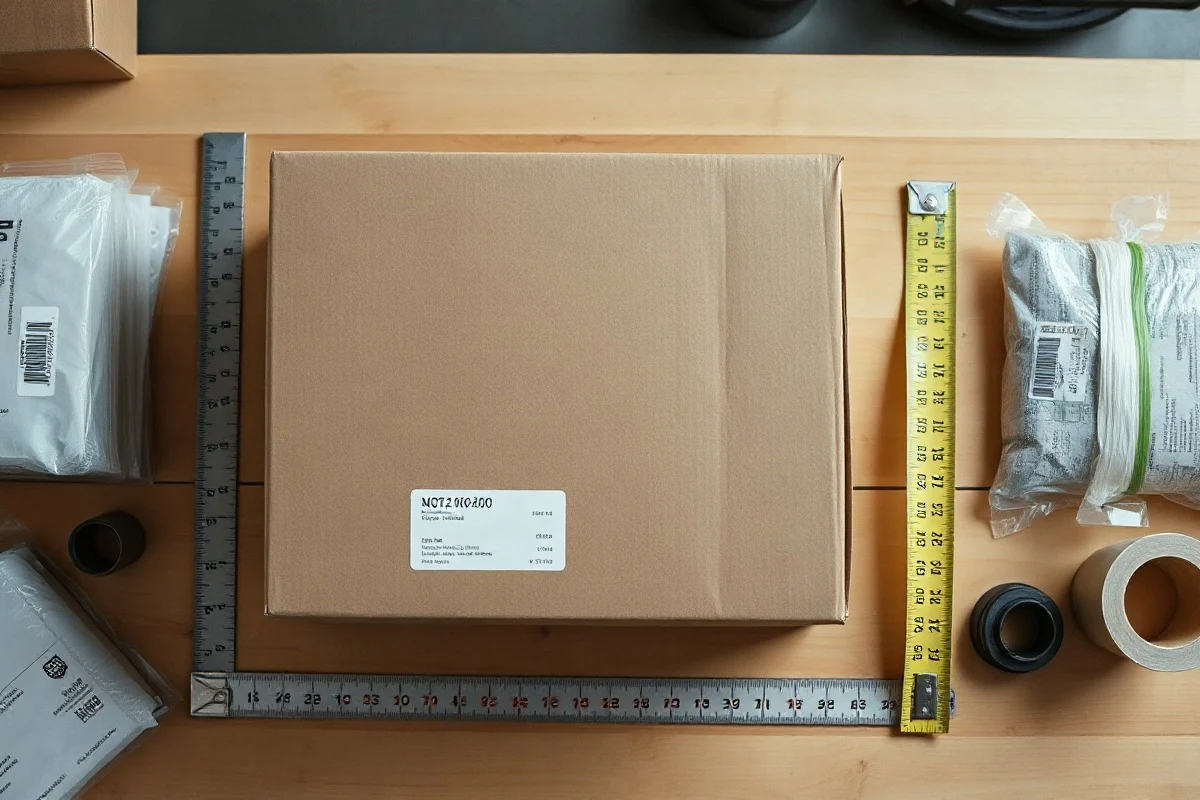
To measure a package correctly, place the sealed parcel on a flat surface and measure its outside dimensions at the longest points: length, width, and height. Record the measurements in the order length × width × height, round according to the carrier or marketplace instructions you are using, and measure the finished package rather than the empty box. Accurate measurements help you compare shipping options, check size restrictions, and estimate whether dimensional weight may affect the price.
What package dimensions mean
Most shipping forms ask for three dimensions:
- Length: the longest side of the package.
- Width: the next-longest side, usually measured across the front or top.
- Height: the remaining side, measured from the bottom of the package to the top.
For a rectangular carton, the dimensions are usually written as length × width × height. A box measuring 18 inches long, 12 inches wide, and 8 inches high should be recorded as 18 × 12 × 8 inches.
The orientation usually does not change the physical size of a rectangular box, but the order matters when entering information into a shipping calculator or preparing a label. If a carrier or marketplace defines a specific method for identifying length, follow that method instead of assuming that any order is acceptable.
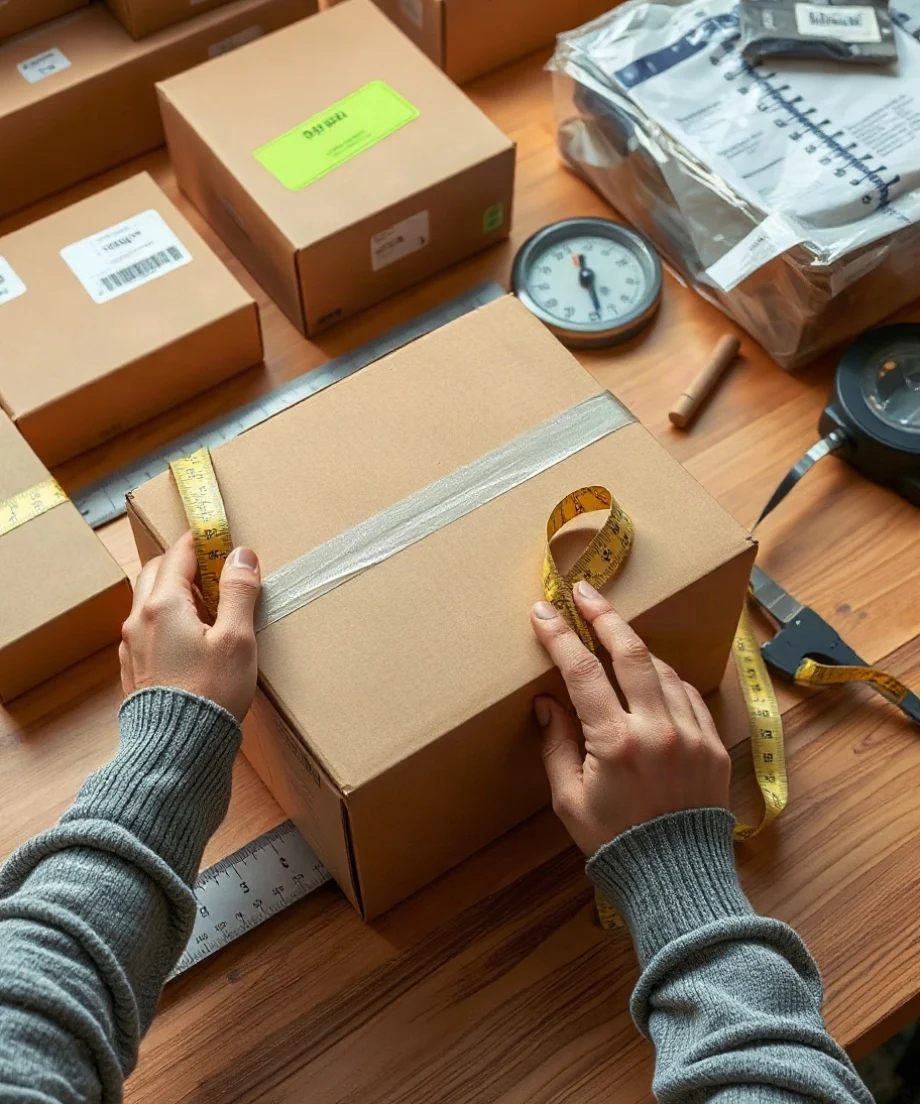
How to measure a box step by step
1. Finish packing the shipment first
Measure the package after the product, cushioning, paperwork, and other contents are inside. Close and seal the box before measuring it. Tape can slightly increase the outside dimensions, and soft packaging materials may bulge once the box is full.
If you measure an empty carton and then pack it tightly, the finished shipment may be larger than your original measurements. That difference can matter when the parcel is close to a size threshold or when dimensional weight is calculated from the outside dimensions.
2. Place the package on a stable surface
Use a hard, level table or floor rather than a bed, couch, or flexible packing surface. Keep the package in its normal shipping position. Do not press down on the box while measuring, because compressing the carton can produce dimensions that do not represent the parcel as it will be handled.
3. Find the longest side
Measure the longest straight edge of the package from end to end. Keep the measuring tape parallel to the edge and read the measurement at the outermost points, including any protruding flaps, protective corners, or other permanent parts of the finished package.
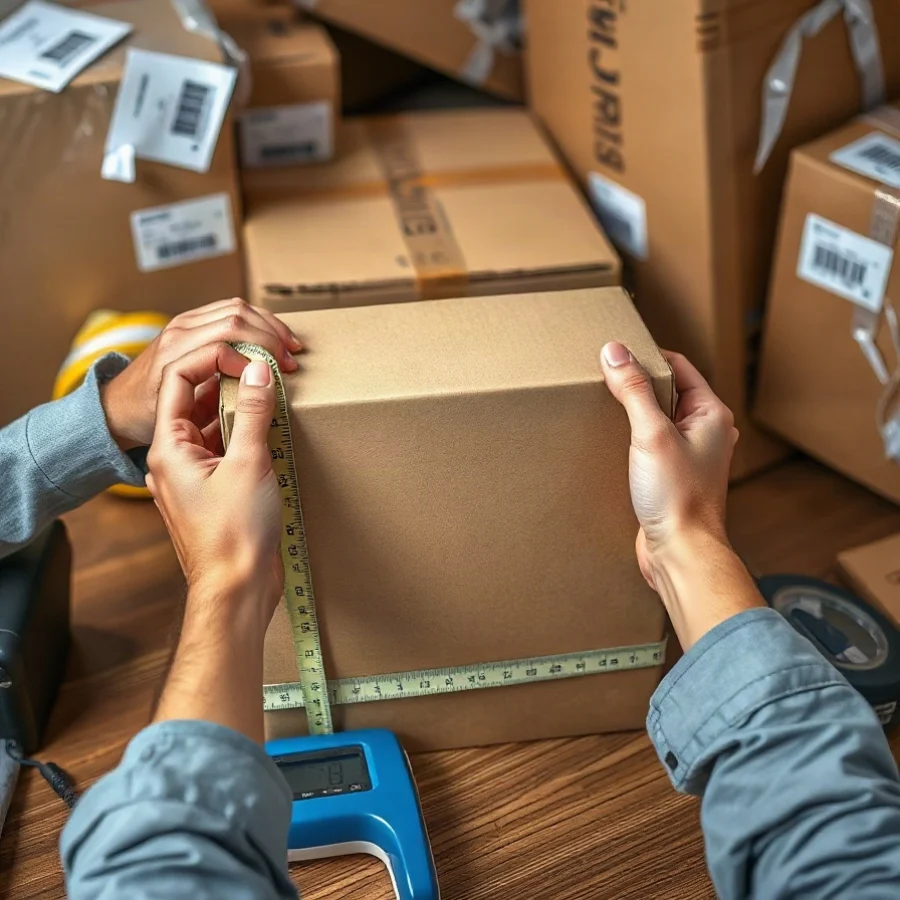
For a standard rectangular box, the longest edge is usually obvious. For an irregular parcel, rotate the package and compare the sides. Use the greatest overall length, not the length of a smaller flat area on the carton.
4. Measure the width and height
Measure the two remaining sides at their widest or tallest points. The tape should run straight across the package rather than diagonally. If the box is bowed, bulging, or uneven, measure the maximum outside dimension instead of forcing the tape against the carton.
When a package has rounded edges, a nonstandard shape, or attached components, check the applicable carrier instructions before entering the measurements. Some services use special methods for irregular packages, and those methods can vary by carrier, service level, package type, and destination.
5. Record the measurements and units
Write down the dimensions immediately in a consistent format, such as 18 × 12 × 8 in. Do not mix inches and centimeters in the same set of measurements. If a shipping form asks for whole numbers, follow its rounding instructions rather than applying a general rule.
It is useful to record the package weight at the same time. The physical weight and the outside dimensions are often needed together when comparing shipping prices or checking whether a parcel meets a service's requirements.
Where to measure soft mailers, bags, and flexible parcels
Flexible packaging can be harder to measure because it changes shape when filled. Pack the mailer completely, close it in the way it will be shipped, and measure the maximum length, width, and thickness. Do not flatten a padded mailer more than it will be flattened during normal handling.
For a poly mailer or soft bag, measure the filled package rather than the product alone. A garment, book, or bundle may create a thicker area in the center. If the parcel has a gusset, include the expanded depth. If the contents shift easily, add enough structure or cushioning to keep the package within the intended shape.
Some carrier services distinguish between parcels, flats, envelopes, tubes, and other package categories. Because the definition and limits may vary, verify the current requirements for the selected service before relying on a flexible package measurement.
How to measure irregular packages
Irregular packages include tubes, triangular mailers, cartons with attached handles, and boxes with bulging sides. Start by identifying the maximum overall dimensions in three directions. Imagine placing the parcel inside the smallest rectangular box that could contain it without compression. The outside dimensions of that enclosing shape provide a practical measurement for many shipping calculations.
For a tube, measure the end-to-end distance as its length and measure the outside diameter. Some shipping systems may use the diameter as both width and height, while others may apply a specific tube rule. Do not assume that a tube is treated exactly like a rectangular box; check the current official rules for the service you plan to use.
If a parcel has an unusual shape or a part that sticks out, photograph the package beside a ruler and keep the measured dimensions with the shipment record. This can make it easier to review a label, quote, or carrier adjustment later.
Calculating package volume
Package volume is found by multiplying the three outside dimensions:
Volume = length × width × height
For example, a box measuring 18 × 12 × 8 inches has a volume of:
18 × 12 × 8 = 1,728 cubic inches
Volume is useful for comparing carton sizes and estimating dimensional weight, but volume alone does not determine the shipping price. The carrier may use the package's actual weight, dimensional weight, minimum charges, service type, destination, and other rules. For a quick comparison, you can use the Box Size Calculator or review the current service information from the carrier.
Dimensional weight and the importance of accurate measurements
Dimensional weight is a pricing method that reflects the space a package occupies in a transportation network. A common structure is:
Dimensional weight = length × width × height ÷ dimensional divisor
The divisor is not universal. It can vary by carrier, service, package type, destination, units, and the current pricing rules. Because divisors and rounding requirements may change, do not use an old divisor from a previous shipment without checking the current official source for the service.
Suppose a shipment measures 24 × 16 × 12 inches. Its volume is:
24 × 16 × 12 = 4,608 cubic inches
The dimensional-weight result would then depend on the applicable divisor and rounding rule. Compare that result with the actual scale weight only after confirming the current requirements. If you need to test different measurements, the Dimensional Weight Calculator can help you work through the calculation.
A small measurement error can have a larger effect on volume than expected. Increasing one side from 12 to 13 inches changes the volume of an 18 × 12 × 8-inch box to 18 × 13 × 8 inches. That is 1,872 cubic inches instead of 1,728 cubic inches, an increase of 144 cubic inches. This is why measuring the sealed package matters, especially when the parcel is near a pricing or size boundary.
Inches, centimeters, and unit conversion
Shipping forms in the United States commonly request inches and pounds, but international services or online systems may request centimeters and kilograms. Convert every dimension before calculating volume or entering the information.
- Inches to centimeters: inches × 2.54
- Centimeters to inches: centimeters ÷ 2.54
For example, a 40 × 30 × 20 cm package is approximately 15.75 × 11.81 × 7.87 inches. Keep extra decimal places during the conversion, then apply the destination system's rounding instructions at the end. Rounding each side too early can change the calculated volume.
Common measuring mistakes to avoid
Measuring the product instead of the package
The shipment is the sealed outer package, not just the item inside. Include the carton, mailer, padding, corner protection, and any other material that affects the final outside dimensions.
Using the inside dimensions of a box
Manufacturers may describe a carton using inside or outside measurements. Shipping calculations generally require the outside dimensions of the completed package, so confirm which measurements you are using and avoid copying an interior size into a label form.
Ignoring bulges and protrusions
Do not squeeze a soft parcel flat or measure around a bulge as if it were part of the box's interior. Measure the maximum outside points that a carrier is likely to handle.
Rounding without checking the instructions
One system may request whole-number dimensions, while another may accept decimals or apply its own rounding process. Use the current instructions for the selected service. If a package is close to a limit, measure carefully and allow practical room rather than relying on a borderline value.
Using old carrier or marketplace information
Size limits, dimensional-weight rules, fees, surcharges, and rounding methods can change. Requirements may also differ among services from the same carrier. Before purchasing postage or creating a marketplace shipment, check the current official source. You can also compare guidance in the Package Dimensions guide, but treat the carrier or marketplace's current terms as the controlling source.
Practical ways to improve measurement accuracy
- Use a rigid tape measure or ruler with clearly marked units.
- Measure each side twice if the package is close to a size or price threshold.
- Keep the tape straight and parallel to the edge.
- Measure the sealed parcel after all tape and protective materials are applied.
- Record length, width, height, weight, and the measurement date for repeat shipments.
- Use the same method for every package in a product line.
- Take a photo of unusual packages beside a ruler for internal records.
For repeat shipments, create a packing specification that lists the finished package dimensions, materials, and target weight. Recheck the specification whenever the product, carton, cushioning, or sealing method changes. Consistent packing makes shipping estimates more reliable and can reveal when a smaller box would protect the product just as well.
Before you buy the label
Use the final packaged measurements and actual scale weight to compare services. Confirm the selected service's current size, weight, shape, and dimensional-weight rules, especially for international shipments, tubes, oversized parcels, and marketplace fulfillment. If the package is near a limit, consider choosing a slightly smaller carton, rearranging the cushioning, or obtaining confirmation from the carrier before shipping.
Correct measurement is a simple process: pack the item, seal the parcel, measure the maximum outside length, width, and height, record the units, weigh the shipment, and verify the current rules for the service you will use. That routine reduces label corrections, unexpected adjustments, and avoidable packaging problems.
Comments
0No comments yet. Be the first to share a helpful note or question.
Leave a Comment
Your email address will not be published. Comments are reviewed before appearing on the site.