
The best standard shipping box size depends on the product, its protective packaging, and the carrier service you plan to use. As practical starting points, small items often fit in boxes around 6 x 4 x 4 inches, books and compact products commonly use boxes around 12 x 9 x 4 inches, and larger retail or household items may need boxes from approximately 16 x 12 x 8 inches to 24 x 18 x 12 inches. These are starting sizes rather than universal standards: the right box should hold the product securely with enough cushioning to prevent movement, but not so much empty space that the package becomes unnecessarily large.
How to choose a shipping box size
Start with the product’s actual dimensions, not the size shown on a product listing or catalog page. Measure the item at its longest, widest, and deepest points. If the product has handles, protruding parts, a rounded shape, or a retail package, measure the complete packaged form that will go inside the shipping carton.
Next, allow room for protective material. A fragile item may need several inches of cushioning around some or all sides, while a durable item in a fitted retail box may need much less. The goal is to create a stable package in which the product does not press directly against the outer walls and cannot move freely when the carton is gently shaken.
For a simple estimate, add the desired cushioning allowance to each product dimension:

Required inside length = product length + cushioning on both ends
Required inside width = product width + cushioning on both sides
Required inside height = product height + cushioning above and below
For example, a product measuring 10 x 7 x 3 inches may fit in a box with inside dimensions of approximately 12 x 9 x 5 inches when it needs about 1 inch of protection on each side. The exact box may differ because manufacturers list carton dimensions in different ways. Confirm whether a box’s measurements are inside dimensions or outside dimensions before ordering a large quantity.
Common shipping box sizes by product type
Small accessories and compact products
Small products such as phone accessories, jewelry cases, small tools, cosmetics, and replacement parts often work well in cartons around 6 x 4 x 4 inches, 8 x 6 x 4 inches, or similar compact sizes. These boxes are useful when the product is already protected by a retail package or when a small amount of paper, foam, or bubble cushioning is sufficient.
Do not select a tiny carton solely because the item itself is small. A glass bottle, ceramic piece, or product with sharp edges may require extra internal protection. In those cases, a slightly larger box can be safer if the additional space is filled with material that keeps the item centered and prevents contact with the walls.
Books, documents, and flat products
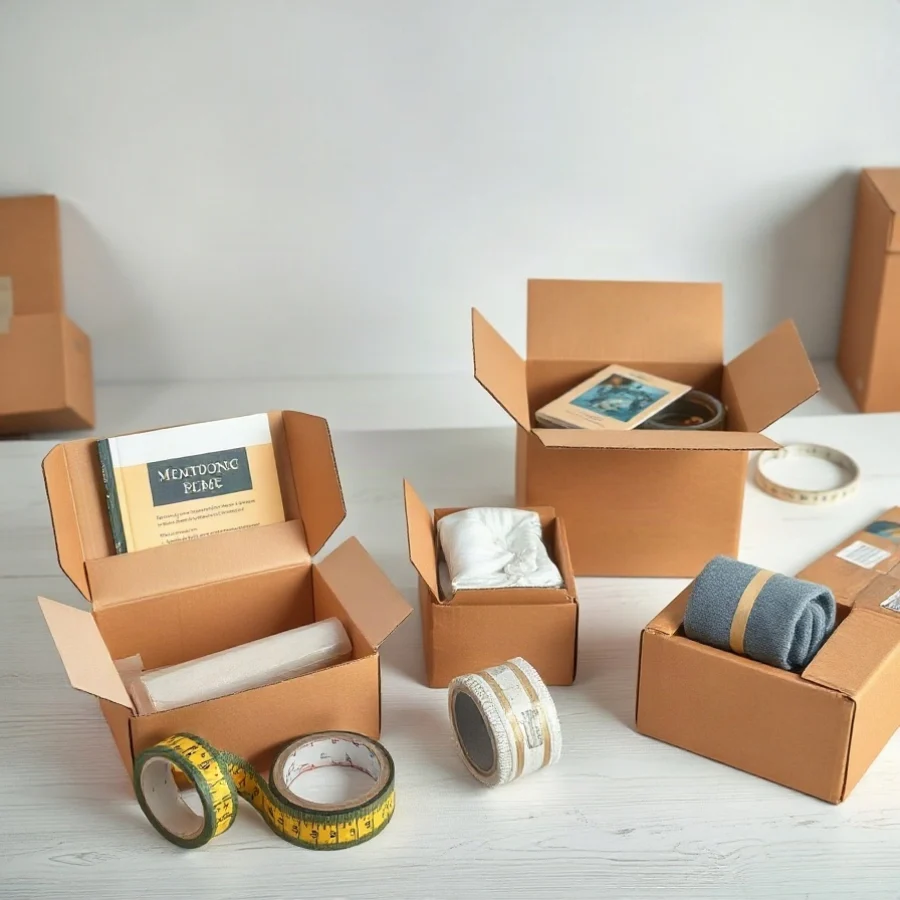
Books, notebooks, calendars, board games, and other flat products commonly fit in boxes around 12 x 9 x 3 inches, 12 x 9 x 4 inches, or comparable sizes. The first two dimensions should be larger than the product’s length and width, while the height should account for the product thickness and a protective layer.
Use a rigid carton for hardback books, stacked books, framed prints, and other items that can bend or dent. If several books are packed together, keep the total weight in mind and reinforce the bottom with a strong strip of packing tape. Place heavier books at the bottom and avoid leaving empty space that allows the stack to shift.
Clothing and soft goods
Folded shirts, sweaters, linens, and other soft goods can often ship in boxes around 12 x 9 x 4 inches, 14 x 10 x 6 inches, or larger cartons depending on the number and thickness of items. Soft products may also be suitable for a poly mailer or padded mailer when the contents are not fragile and the shipment does not need the structure of a box.
Choose a box that lets clothing lie flat or fold naturally without excessive compression. For one or two lightweight garments, an oversized carton creates avoidable empty space. For multiple garments, measure the packed stack rather than estimating from the unfolded dimensions.
Shoes and footwear
A single pair of adult shoes often fits in a box around 14 x 10 x 5 inches, although boots, large footwear, and shoes in retail boxes may require more length or height. Measure the shoebox or the arranged pair, including any heel or toe protrusions. Use tissue paper or light cushioning to prevent scuffing and fill gaps around the retail box if it can slide inside the shipping carton.
Electronics and small appliances
Small electronics, computer accessories, kitchen gadgets, and compact appliances frequently use cartons in the range of 12 x 9 x 4 inches to 18 x 14 x 8 inches. The proper size depends heavily on whether the original manufacturer packaging is being used. Original packaging often has molded protection, but it may still need an outer box for shipping.
Protect screens, corners, controls, and other vulnerable surfaces. Wrap cables and loose accessories separately so they do not scratch the main unit. If the product contains a battery, review the current requirements for the battery type, transportation method, and destination before shipping. Carrier and regulatory requirements can change, so verify details with the applicable official source.
Dishes, glassware, and fragile household items
Plates, mugs, vases, and glass containers need more planning than their basic dimensions suggest. A box around 12 x 12 x 12 inches may work for a small collection of compact items, while larger sets may need a carton around 18 x 18 x 12 inches or more. These examples are not guarantees; the quantity, shape, and type of cushioning determine the final size.
Wrap each item individually and separate pieces with dividers or cushioning. Place heavier pieces below lighter ones. Keep fragile items away from every wall of the carton and fill all voids so the contents do not shift. A double-wall carton may be appropriate for heavier or especially delicate products, but the package still needs careful internal protection.
Gifts, subscription products, and retail orders
Gift boxes and subscription shipments often use cartons around 10 x 8 x 4 inches, 12 x 10 x 6 inches, or 16 x 12 x 8 inches. Select the smallest size that accommodates the products, presentation materials, and cushioning without crushing the contents. If the package includes tissue paper, inserts, product cards, or a gift box, measure the complete arrangement before selecting the shipping carton.
Box measurements: inside versus outside dimensions
Shipping boxes are commonly described using length, width, and height, but sellers may publish either inside or outside measurements. Inside dimensions are most useful for checking whether a product will fit. Outside dimensions are important when estimating the space occupied during transportation or entering package dimensions into a shipping system.
Measure a sealed package from the longest points of the finished carton. Do not measure only the flat cardboard before assembly. For a rectangular box, record the dimensions in the same order every time, such as length x width x height. Round measurements consistently, and follow the carrier or shipping platform’s current instructions when it requires a particular entry method or rounding practice.
For more guidance on measuring a finished parcel, see this package dimensions guide.
How box size affects dimensional weight
A large, lightweight box may cost more to ship than a smaller, heavier box because some services compare actual weight with dimensional weight. Dimensional weight is calculated from the package’s length, width, and height using a divisor established by the carrier and service. The billable weight may be based on the greater applicable value, but the exact formula, divisor, rounding method, and service rules vary.
Use this general structure only as a planning concept:
Dimensional weight = length x width x height ÷ applicable dimensional divisor
Do not assume that one divisor applies to every carrier, service level, destination, or package type. Check the current official rate or service documentation before calculating a quote. You can also compare the effect of different cartons with a dimensional weight resource.
Reducing empty space can help control dimensional weight, but downsizing should never remove necessary protection. A crushed product, damaged corner, or failed seal can cost more than the extra packaging material or shipping space.
Practical packing steps
- Inspect the product. Identify fragile surfaces, loose parts, sharp edges, and areas that need special protection.
- Prepare the inner package. Use the manufacturer’s packaging when it is clean, intact, and designed for the item. Otherwise, wrap and cushion the product appropriately.
- Choose a sturdy carton. Avoid cartons with water damage, crushed corners, weak seams, or excessive wear.
- Protect the bottom. Add cushioning or a folded layer of material before placing the product inside.
- Center the contents. Keep the product away from the walls and corners, especially when shipping glass, ceramics, electronics, or framed items.
- Fill voids. Use enough material to stop movement without forcing the carton closed.
- Test the closure. The flaps should meet naturally without bulging. If the box is overfilled, use a larger carton.
- Seal and measure. Apply suitable packing tape, then measure and weigh the finished parcel.
Choosing an economical box without underpacking
For recurring shipments, create a short list of box sizes that match your most common products. Measure several packed orders and look for patterns. A small range of carton sizes can simplify storage and purchasing, but forcing every product into one box often produces either damage risk or unnecessary dimensional weight.
Keep a record of the product dimensions, selected box, finished package dimensions, packed weight, and any damage or customer complaints. This information can help you refine your packaging over time. Before using a box for a particular marketplace or fulfillment program, check the current program requirements directly. Marketplace packaging rules and carrier requirements may vary by product category, destination, service, and date.
For additional packaging references, browse the box sizes section of Package Size Guide. The most reliable choice is usually the smallest sturdy box that protects the product, closes without strain, and meets the current requirements of the service you intend to use.

Comments
0No comments yet. Be the first to share a helpful note or question.
Leave a Comment
Your email address will not be published. Comments are reviewed before appearing on the site.